
In many ways, children’s lives today are not drastically different than those of their parents. The morning routine is still the same: complaining when the alarm goes out, rushing to brush teeth, scrambling to find backpacks, and running to catch the bus. After school is a constant struggle of trying to squeeze in time for lessons, sports, friends, homework, a healthy meal, and a good night’s sleep. The key difference from our childhood and that of our children’s is that every aspect of their lives is now connected and infiltrated by technology.
Electronics are now even an integral part of our child’s education. Both of my school-age children, in addition to their personal iPhones, are tethered to iPads supplied by the school. Digital textbooks, enrichment support materials, and Rosetta Stone language lessons are loaded onto their school supplied iPads. School assignments can be submitted electronically. If there is a question about an assignment, I no longer need to send in a note to the teacher, my child will just email or direct message their instructor. Grades and general communication to parents are posted instantly on parent portals.
CREATING THE PERFECT STORM OF TECHNOLOGY ADDICTION
If you think your child is spending too much time in front of their screens and worry that they may be addicted to technology, trust your instinct. Your children probably are addicted and so are most parents. See how you and your kids fare on the Parent-Child Addition Test Test from Net Addiction.
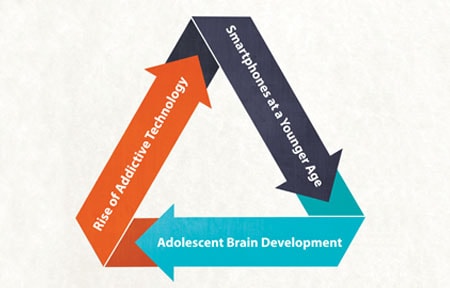
Unconsciously, many well-intended parents have participated in a perfect storm trifecta leading to our children’s addiction to technology: (1) Rise of addictive technology, (2) Smartphones given at a younger age, (3) Adolescent brains not fully developed.
RISE OF ADDICTIVE TECHNOLOGY
Parents number one job is to keep our children safe. However, keeping our kids and ourselves from becoming addicted the technology is becoming increasingly difficult. New York Times bestselling author Adam Atler’s latest book Irresistible: The Rise of Addictive Technology and the Business of Keeping Us Hooked, has illustrated perfectly how technology companies are getting us hooked to spend more time on their apps and platforms by using the psychology of colors, sounds, and learned behaviors to get and keep us addicted to technology. Atler states in his book:
“Greg Hochmuth, one of Instagram’s founding engineers, realized he was building and engine for addiction. ‘There’s always another hashtag to click on,’ Hochmuth said. “Then it takes on its own life, like an organism, and people can become obsessive. Instagram, like so many other social media platforms, is bottomless. Facebook has an endless feed; Netflix automatically moves on to the next episode in a series; Tinder encourages users to keep swiping in search of a better option. Users benefit from these apps and websites, but also struggle to use them in moderation. According to Tristan Harris, a “design ethicist,” the problem isn’t that people lack willpower; it’s that “there are a thousand people on the other side of the screen whose job it is to break down the self-regulation you have.”
It is important to remind ourselves that the tech geniuses that create technology platforms, games, interactive experiences, streaming services, and apps are also gifted marketers. Before releasing their products and services to the general public they run thousands of tests to determine which background color, badge, sound, font, filter, graphic treatment, or behavioral reward will get you to spend the maximum amount of time on their app. Once launched, they are constantly tweaking the experience to get you addicted to come back for more (or ideally never leave). As parents, we need to be diligent in understanding how much time – and on what apps or websites – our children are spending their time.
AGE KIDS GET THEIR FIRST SMARTPHONE
The age kids are getting smartphones creeps younger all the time. Nielsen just released a report on the age kids get their first smartphone with a full-service plan (voice, messaging, data). The study found:
- 45% of kids, slightly less than half, received a smartphone with a service plan at 10-12 years old.
- The most popular age when a child got a smartphone was 10 (22%).
- However, 31% of kids got their devices at even younger ages with 16% at age 8 and 15% at age 9.
I must admit my youngest child received her smartphone at 10-years old as well. My husband and I had not planned on getting her a full-service phone at that age, in fact we prided ourselves on not caving into the pleas that “everyone else has one”, but when our youngest child was put in a dangerous situation by no fault of her own, we purchased a phone for her so she could always contact us. We are not alone, the #1 reason why parents purchase a smartphone for their child under the age of 13 is so they can easily contact their child or their child can contact them.
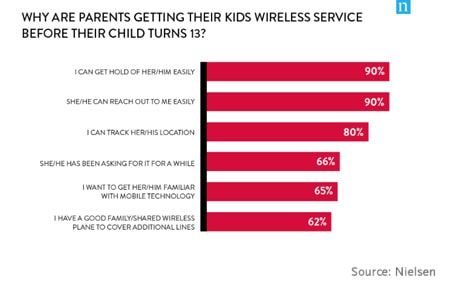
Providing a smartphone to your child makes it easier to reach them but parents who participated in the Nielsen’s survey also expressed concern about:
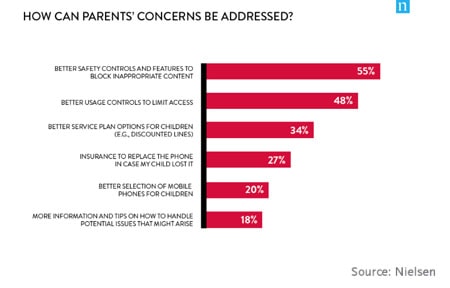
- Their kids losing their phone (77%)
- Smartphones being a distraction (72%)
- Too much time spent on the device (71%)
- Lack of control as to what content their child can view (68%)
Luckily most of the parental concerns can be addressed by implementing parental controls either on the device or via a downloadable app.
THE ADOLESCENT BRAIN
There is a reason why your adolescent child needs to be told what to do multiple times, can get easily distracted, lacks impulse controls, responds to peer pressure and can get easily addicted to technology. While the human brain reaches its full size by age 10, neurologically speaking, the adolescent brain has not fully developed and there is a mismatch between two major brain regions: (1) Limbic region that regulates emotion, and (2) Prefrontal cortex that helps manage impulse control. Per Jay N. Giedd, Director of Child and Adolescent Psychiatry at the University of California, “The prefrontal cortex functions are not absent in teenagers; they are just not as good as they are going to get. Because they do not fully mature until a person’s 20s, teens may have trouble controlling impulses or judging risks and rewards.”
There is not much a parent can do to rush the process of your child’s neurological maturity, but we can equip them with guardrails to keep them safe until their brain is more fully developed. Jessie Weinberger, who wrote the smartphone and internet safety book “The Boogeyman Exists: And He’s in Your Child’s Back Pocket,” said she surveyed 70,000 children and found that, on average, sexting began in the fifth grade, pornography consumption began when children turned 8, and pornography addiction began around age 11. Parents need to help their children grow the skills needed to control impulses, plan ahead, and resist peer influences; as well as use parental controls to limit exposure and temptations.
FAMILY CONTRACTS THE FIRST LINE OF DEFENSE
Ultimately, only parents can determine if their child is ready for a smartphone and if the pros outweigh the cons. If you determine that your child is truly ready for a smartphone, before shopping for one, sit down with your child and determine what house rules and limits will be part of the privilege of getting a phone. Whatever rules are agreed upon, include them in a family contract signed by both the child (or children) and parents, before a phone is purchased. Make it clear to your child that if they break house rules; phone privileges will be suspended.
PARENTAL CONTROLS
There are a variety of parental controls available on most device phone settings, as well as downloadable apps. For iPhones and other Apple products (iPad, MacBook) parent controls, there are several options parents can enable or disable. The iPhone’s parental controls live inside the settings app. Windows 10 and Kindle parental controls also have a number of built-in options you should explore. Most Android phones are deficient in similar built-in parental control settings.
It is unrealistic to think you can shield your child from all addictive technology, but with the proper tools in place, parents can help their children to not only be entertained but also be enriched and enlightened with all the amazing options right at their fingertips.



 Whether by Android, iPhone, Snapchat or Instagram, researchers say that a hurtful word or picture can impact children as much as a physical blow – and with a lasting impact.
 Dillon Public Library