Thanks to the Community of Dillon for coming together to help us celebrate the eclipse in Jaycee Park. Here is the link to some fun photos.
Blog
Solar Eclipse
15 Tips for Kids Viewing the Solar Eclipse

In a perfect end to summer, some parts of North America, South America, Africa and Europe, will be able to view the August 21st solar eclipse. Depending on your location, you may be able to view at least a partial eclipse. Total eclipses are rare, with the last one the entire United States was able to view was in 1979. This is an event you won’t want your kids to miss. I’ve gathered 15 tips for kids viewing the solar eclipse, so your family can witness the rare event safely.
WHAT IS A SOLAR ECLIPSE?
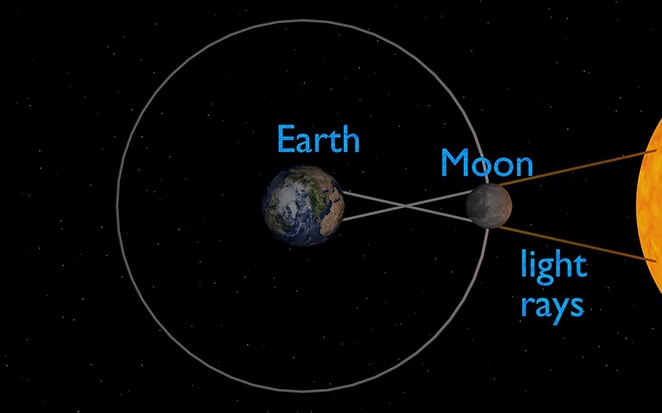
Perhaps the most stunning visual representation of planetary orbit, a solar eclipse occurs when the Moon passes between Earth and the Sun, eclipsing or covering the Sun from view from Earth anywhere from several minutes to several hours.
For a more thorough and kid-friendly explanation of a solar eclipse, check out this short video:
WHY CAN IT BE DANGEROUS TO VIEW AN ECLIPSE?
As a child, I remember the chatter amongst friends in the days leading up to a partial eclipse. Playground talk was dominated by talk of going blind by looking directly at the eclipse, and tales of knowing someone who’d gone blind by ignoring the rule were regaled in hushed tones. So, what’s the truth behind it? Is it really dangerous to view a solar eclipse? Yes and no.
The odds of going completely blind by viewing a solar eclipse without proper eye protection are slim, but your eyes can be permanently damaged. Much like the way a camera works, staring directly at the Sun damages the retina, leaving an afterimage “burned” into our retina; you’ve likely experienced a similar effect having your picture taken with a flash in the dark. Most people can’t stare directly at the Sun on a normal day, but during a partial eclipse, sunlight is not as intense, tempting people to view the phenomenon without proper eye protection. Unfortunately, eyes can still be damaged, despite the ability to look directly into the Sun without the urge to squint. However, the Sun can be viewed with the naked eye during a total eclipse, but only during the time that the Moon is completely covering the Sun. This essay in Scientific American explains the science behind why and how eye damage occurs when viewing the Sun without eye protection.
WHY ARE ECLIPSES A BIG DEAL?
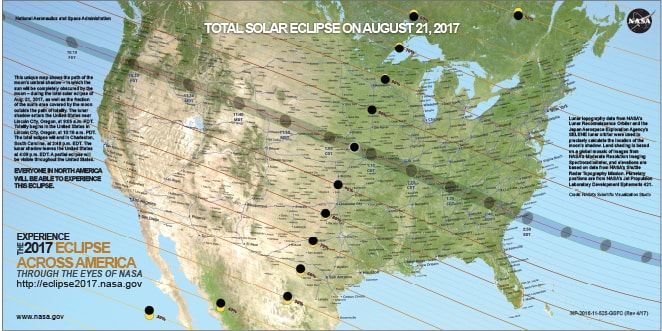
While annular eclipses are common, the odds of being in an area to witneass a total solar eclipse makes this a once-in-a-lifetime experience. If you have the opportunity to travel to an area that will experience a total solar eclipse, do it!
HOW TO MAKE THE MOST OF THE ECLIPSE
If you’re not in a position to travel to an area in the United States that will experience a total eclipse, all is not lost. Areas outside the band on NASA’s interactive maps will experience a partial eclipse, which is still a wonder to experience. Here are some ideas for making the most of your eclipse experience:
ECLIPSE ACTIVIES FOR KIDS
A solar eclipse is the perfect way for children to take part in science — they’ll be able to see it, experience the darkness and feel a noticeable temperature drop once the Sun is covered. So much about parenting is being able to spot teachable moments, and this is an exciting moment that everyone can enjoy.

-
- If you have younger children, you can still get them excited and involved with free, downloadable solar system coloring pages from 123 Homeschool 4 Me.
- While many educational sites offer downloadable STEM activity kits for a low purchase price, NASA is offering a free, downloadable eclipse kit. NASA’s kit includes traditional activities involving cardboard, paper and pencils, as well as activities that utilize digital technology, such as a smartphone or camera. Families can choose from 14 activities, each with a recommended grade level, ranging from Kindergarten through 12.
- Get crafty and make a DIY pinhole camera with these instructions from NASA.
- Use this free download from NASA for a 2D/3D Pinhole Projector in the shape of the United States and/ or the state in which you’re viewing the solar eclipse.
- Craft an Eclipse Viewer from a cereal box with this Hila Science Camp activity.
- If your kids aren’t especially interested in the science behind solar eclipses, they might be interested to learn about solar eclipse myths from cultures around the globe. National Geographic discusses the origins of the many myths and legends that surround eclipses in different parts of the world.
- Bring a thermometer out with you, and take guesses on how far the temperature will plummet during the eclipse. As the Moon starts to move into position, watch the thermometer closely, you’ll likely be surprised by how cold it becomes during total eclipse!
- If you’re looking for a more low-key, less hands-on approach to learning more about solar eclipses, apps are the way to go. Space.com has done the work for you, and chosen 7 of the Best Total Eclipse Apps for August 21.
TIPS FOR VIEWING THE ECLIPSE
- If you’re simply looking for a quick reference guide to safely viewing the solar eclipse, NASA offers a quick, bulleted list of safety tips.
- Check to see if there are any eclipse events taking place locally and make a day of it! Many science centers, libraries, museums and planetariums will be hosting events across the country.
- If you’re purchasing glasses for viewing solar eclipse, beware of counterfeits. Many advantageous businesses are attempting to cash in on the solar eclipse…at the expense of safety. Use this guide from NASA to purchase glasses, or check to ensure that the glasses you’ve already purchased are safe for use.
- Plan a potty break. If you’re attending a viewing event, make sure everyone has used the restroom well in advance of the eclipse. The last thing you want to do is try to find a bathroom in the minutes leading up to the event (or being stuck in a bathroom during totality)!
- Take photos leading up to the event, but put the camera down during total eclipse so that you can fully enjoy it. When you’re done, NASA wants you to post your photos on social media with #EclipseSelfie.
- Take it in. Two-and- a-half minutes goes by quickly, so make the most of that time, free from distractions.
- After the eclipse, take time to record video of your child’s reaction to the once-in- a-lifetime event. You’re preserving the experience of a lifetime, something the entire family can look back on ten or twenty years down the road.
Experiencing a solar eclipse is an amazing opportunity for educating and spending time with our kids. If you’re crafty, you’ll enjoy making your own eclipse viewers, while those of you who are a little more hands-off (like myself), will enjoy exploring some of the eclipse apps with your kids. Please remember to view the eclipse safely, with proper eye-wear or a projection device — it only takes a few moments to irreparably damage your eyes. Most of all — have fun!
Blue Whale Challenge
Blue Whale Suicide Challenge is Claiming Teens’ Lives

Challenges and teens have gone hand in hand long before the invention of mobile phones or social media. The party game “truth or dare” has been played for centuries, dating back to ancient Greeks. Today, social media introduces these dares to entirely new audiences, causing challenges to go viral. For many teens, peer pressure combined with FOMO (fear of missing out), makes it very difficult to not only participate in but also to seek out some of these viral challenges.
Challenges can be found for almost any interest or desire, with some of the most viral ones listed below:
- Pop culture fads — Mannequin Challenge
- Charity — ALS Ice Bucket Challenge
- Jimmy Fallon fans — Whisper Challenge
- Humor —Try Not to Laugh Challenge
- Eating — Hot Pepper or Cinnamon Challenge
- Health risk — Salt and Ice Challenge
The Blue Whale Challenge takes health risk challenges to a whole new level, since to “win” the challenge a player must commit suicide. There is much speculation if this challenge is an urban legend, an internet hoax, predators praying on impressionable teens, or a very real viral threat.
WHAT EXACTLY IS THE BLUE WHALE CHALLENGE?
The Blue Whale Challenge is a social media game that involves victims completing an increasingly dangerous daily task over a 50-day period. The only way to “win” the game is to die by suicide.
WHAT HAS BEEN REPORTED
- Many law enforcement officers, parents, and teachers are very concerned this is a real game that is gaining momentum.
- Teens that are interested in joining the challenge post using the hashtags #bluewhalechallenge, #curatorfindme, #i_am_whale on Twitter or Instagram to connect with a group administrator, curator or taskmaster.
- If selected, a curator sends a daily challenge that can range from watching a scary movie in the middle of the night, self-mutilation, drinking bleach or standing on the edge of a roof.
- Targeted 10 to 14-year-olds players are required to send daily photo evidence to their “group administrator” to prove that they have completed each specific task.
- To win the game the player needs to complete the last task and commit suicide.
Reddit has posted a list of the 50-day task list that a number of people obtained from individuals playing the game. So far, the Blue Whale Challenge is being blamed for over 100 teen suicides across the globe.
The true impact of the loss of teens’ lives due to playing the Blue Whale Challenge is difficult to measure, but one in five teenagers in the U.S. seriously considers suicide annually, according to data collected by the CDC. The American Psychological Association states that suicide is the second leading cause of death for people ages 15 to 24. Since the alleged interaction between curator and victims occurs on social media, linking specific deaths to the Blue Whale Challenge is difficult to stop unless parents can view online activity on their child’s phone.
Even how the Blue Whale Challenge has gotten its name is up for debate. Some hypothesize it is from opening lines of Russian rock band Lumen’s song “Burn.” According to Bloomberg, the lyrics reference a “huge blue whale” struggling to “break through the net.” Another explanation is the mythical story of blue whales purposely beaching on land to die.
TWO US TEENS’ DEATHS LINKED TO THE BLUE WHALE CHALLENGE
The first American death currently being investigated is 15-year-old Isaiah Gonzales, who was found hung in his closet. Next to his body was a cellphone propped up on a shoe, live streaming his own suicide. His family recently gave an interview to ABC’s San Antonio, TX Affiliate KSAT. Jorge Gonzales, Isiah’s father, tragically had a conversation with their son about the Blue Whale Challenge and Isaiah told his father that he had heard of it, but would never participate.
After his death, Isaiah’s family discovered he had been sending pictures of the completed Blue Whale tasks to his friends and even told them that the final task would be suicide. Isaiah’s sister, Scarlett Cantu-Gonzales, said, “They [his friends] blew it off like it was a joke and if one of them would have said something, one of them would have called us, he would have been alive.”
The Gonzales family is now speaking out to raise awareness of the Blue Whale Challenge and asking parents to be proactive about what their children are doing online. “I want [parents] to go through their phones, look at their social media,” Mr. Gonzales said. “If they’re on that challenge already, they can catch that from happening.”
Isaiah’s story is not the only American child potentially linked to the Blue Whale Challenge. Earlier this week, a Georgia woman told CNN that her 16-year-old daughter had killed herself as part of the challenge, but asked that their names not be used.
Nationally, the Associated Press reports that educators, law enforcement officers, and parents have raised concerns about the challenge, though these two back-to-back deaths mark the first allegations in the United States about deaths directly linked to the online game. Internationally, suicides in Russia, Brazil, and half a dozen other countries have already been linked to the challenge.
WHAT PARENTS CAN DO
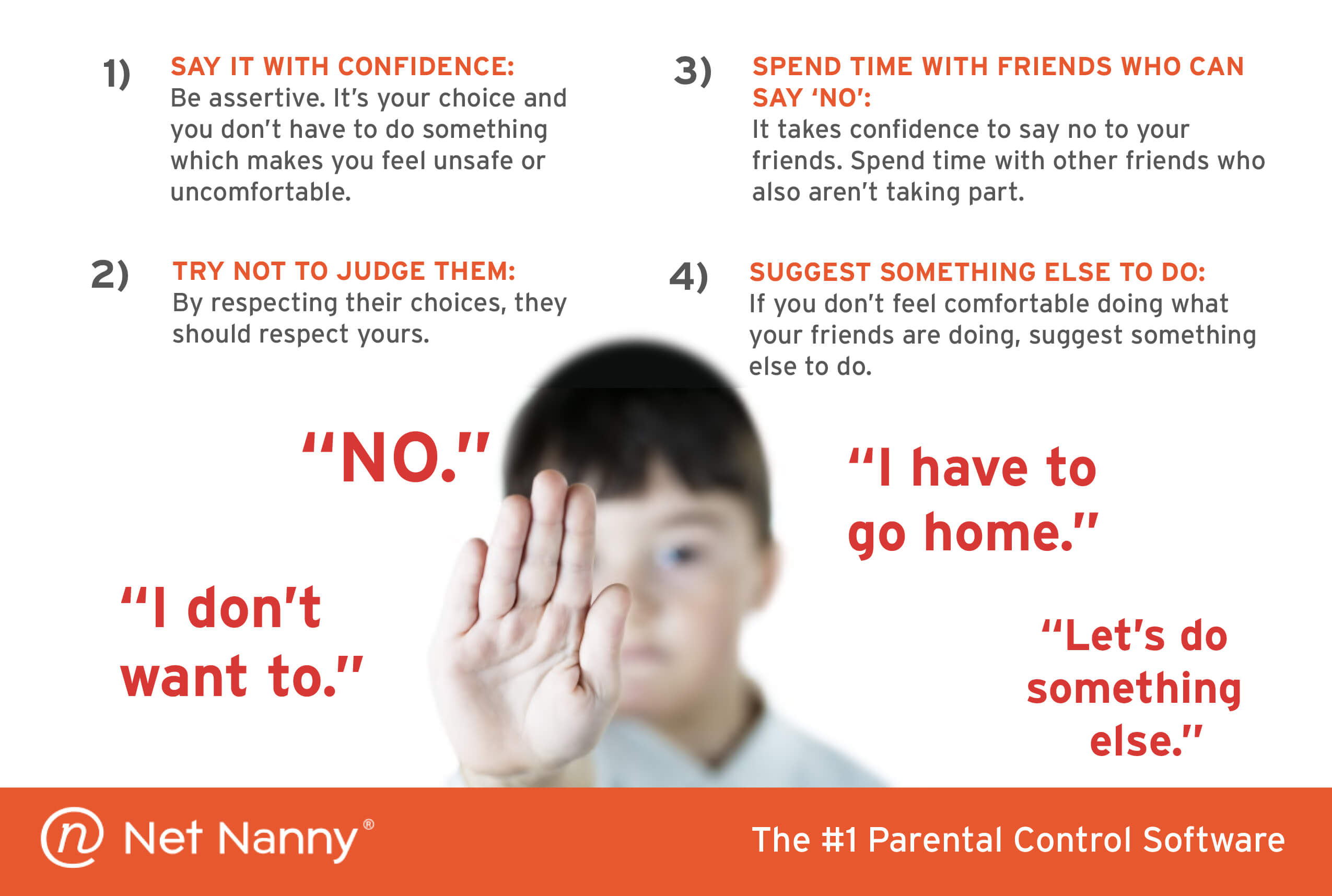
Peer pressure – especially when it relates to social media – can make it challenging for kids to say no to not joining viral challenges. Many times, young people feel they have no option other than saying yes to be accepted. Parents need to remind children it’s not okay for friends to pressure them and they can still be accepted by their true friends even if they don’t go along with the crowd. Especially if the act is something that makes them uncomfortable or involves self-harm.
Below are some helpful suggestions for parents on how to talk to kids about peer pressure and suggestions to give to kids on how to say no, provided by Childline.
See all the suggestions here.
The Blue Whale Challenge is a tragic reminder of the many dangers and vulnerabilities that children face using various social media and apps online every day. It is important for parents to be the first and last defense in keeping their kids safe online, but sometimes (like in the case of the Gonzalez family) having a conversation is not enough. To be vigilant, parents need parental control software like Net Nanny to receive alerts when their children search for content that is inappropriate such as suicide, drugs, violence, or porn.
carpeting
The library is close till August 5th while we are carpeting. You can place any books in the blue bin at the front door or keep them till we reopen. Check out our Facebook page for the latest updates!
![3083588[1]](https://dillonpubliclibrary.org/wp-content/uploads/2017/07/30835881.jpg?w=1080)
4th of July
Hello all,
We will be closed for the 4th of July. We will reopen on the 5th of July with new hours at 9am. Have a safe and fun filled 4th!
We have new hours!!!! The Dillon Public Library will now be open new and extended hours beginning July 3rd, 2017. We will be open from 9am-6pm so come and visit us. Hope everyone is having a great day.
This Blog will be keep you posted on all the new changes in the library.
 Dillon Public Library